
Hairline Restoration in Visakhapatnam
The hairline frames the face, and it is the one part of a hair transplant that people look at directly. Hairline restoration is therefore as much design as surgery: position, shape, angle, density gradient and irregularity all have to be right for the result to be undetectable.
- Grafts required
- 1,200 – 2,500 typically
- Procedure time
- 5 – 8 hours
- Technique
- FUE or FUT with single-hair front row
- Back to work
- 2 – 4 days
- First growth
- 3 – 4 months
- Final result
- 12 months
The art of hairline design
A natural hairline is never a straight line and never perfectly symmetrical. It has a soft transition zone of fine single hairs, a slightly irregular leading edge, gradually increasing density behind it, and defined but not sharp temporal points. Reproducing that irregularity deliberately is what makes surgical work invisible.
Position is decided anatomically, not by preference alone. The mid-frontal point is generally placed where the forehead begins to curve from vertical to horizontal, commonly measured at around seven to nine centimetres above the glabella depending on facial proportions. Placing a hairline too low may look impressive at 28 but becomes conspicuous at 50 as surrounding hair recedes, and it consumes donor grafts that will be needed later.
Age-appropriate design also considers the temporal recession that is normal in adult men. A mature hairline with slight temporal recession reads as natural; a flat juvenile hairline transplanted onto a 40-year-old face does not.
Transition zone
One to two rows of single-hair grafts placed irregularly so the edge is soft rather than abrupt.
Defining zone
Higher-density placement immediately behind the transition zone to create the visual line.
Temporal points
Angled, feathered corners that restore the frame of the face without over-lowering it.
Frontal tuft
A slightly denser central zone that carries most of the visual impact of coverage.
Micro-irregularity
Deliberate small zigzags and sentinel hairs ahead of the line, mimicking nature.
How hairline restoration is performed
Hairline work uses the same harvesting techniques as any transplant, but the placement discipline is considerably finer.
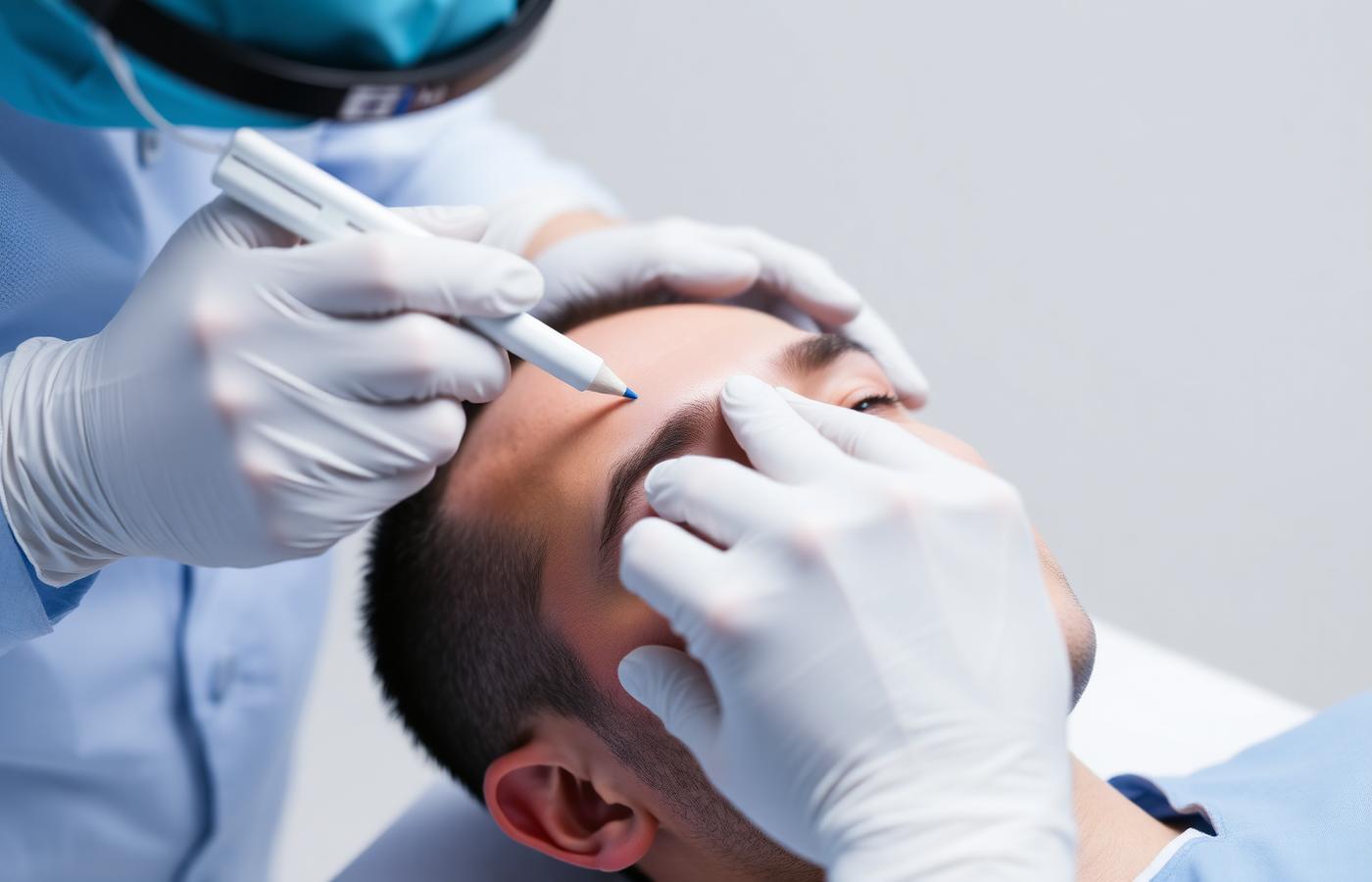
1. Facial mapping
Measurements from the glabella, facial thirds and forehead curvature establish the correct hairline height.
2. Approval in the mirror
You review the drawn line seated upright, and adjustments are made before consent.
3. Graft harvesting
FUE or FUT is used, with single-hair units carefully identified and reserved for the front row.
4. Angle-matched site creation
Incisions in the frontal zone are made at 15 to 25 degrees, pointing forward, matching native emergence.
5. Graded placement
Single hairs at the edge, doubles behind, triples deeper — creating a density gradient the eye reads as natural.
6. Symmetry check
The line is checked from front, three-quarter and overhead views before completion.
Benefits of hairline restoration
Restoring the hairline changes how the whole face reads, often more than any other cosmetic procedure of comparable invasiveness.
Restores facial framing
A defined hairline visually shortens the forehead and rebalances facial thirds.
Permanent single-hair precision
Front-row grafts come from the permanent zone and never recede.
Undetectable at close range
Correct angling and irregularity survive scrutiny in bright light and in photographs.
Freedom to style back
You can push your hair back or wear it up without concealing anything.
Repairs previous work
Poorly angled or pluggy old hairlines can be softened and corrected.
What results look like
In the first two weeks the new hairline is visible as tiny crusts arranged along the designed line. By week four the area looks unremarkable, and between weeks four and eight the transplanted shafts shed — a stage that surprises patients who have not been prepared for it.
Growth begins around month three as fine, sometimes curly hair. By month six the shape of the hairline is clearly visible, and by month twelve it carries full calibre and can be styled normally. Our documented before-and-after gallery shows the same patients photographed under identical lighting and camera settings at baseline and at twelve months.
Answers
Hairline Restoration — FAQs
Ready to see what your hair can look like again?
Book a consultation with our hair transplant surgeon for a trichoscopic assessment, an honest graft estimate and a written treatment plan.