
Follicular Unit Extraction
FUE Hair Transplant in Visakhapatnam
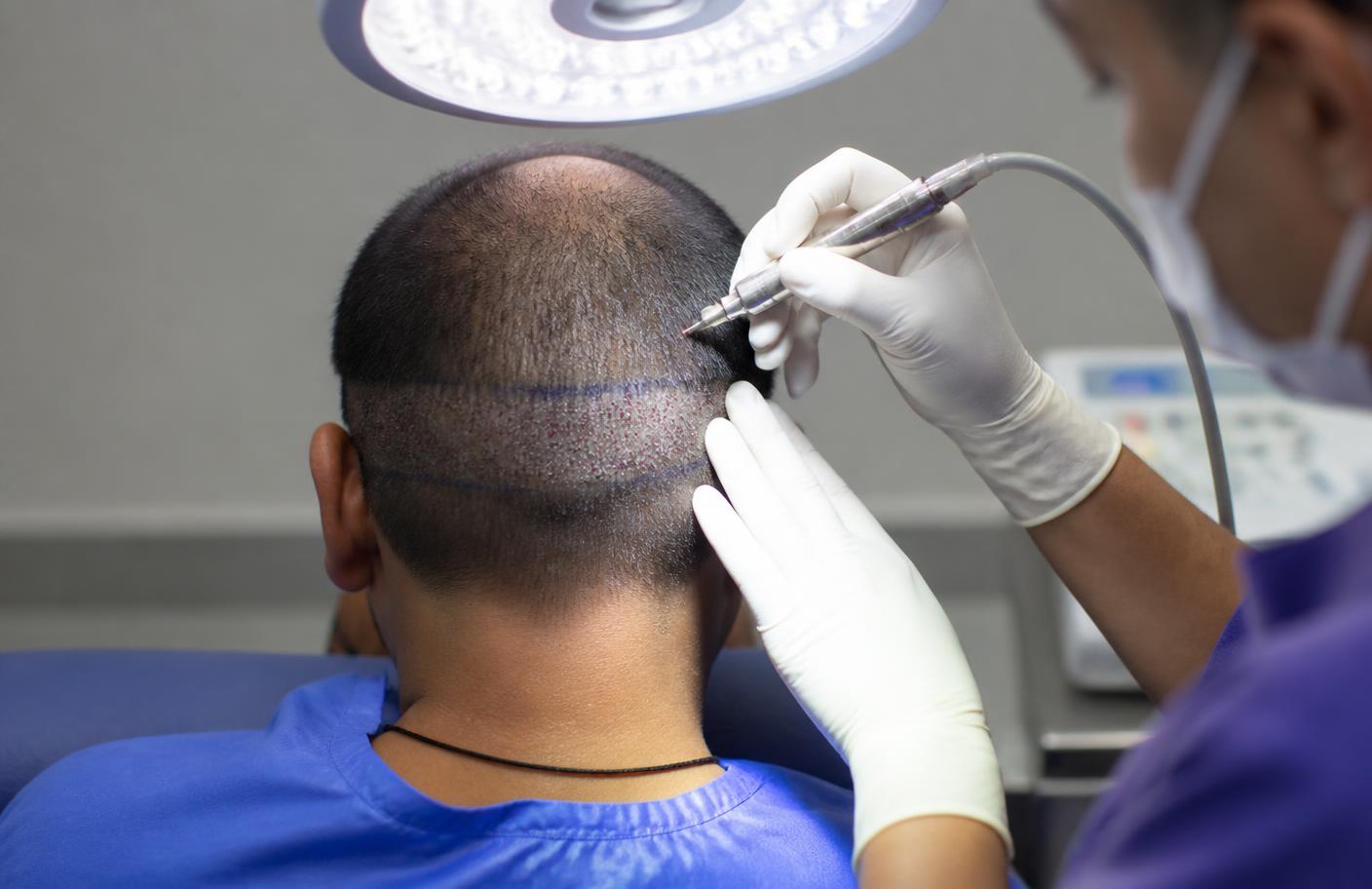
Follicular Unit Extraction (FUE) is the most requested hair restoration surgery at our Visakhapatnam clinic. Individual follicular units are harvested one at a time from the permanent donor zone and re-implanted along a hairline designed for your face — no linear scar, no stitches, and a return to desk work within two to three days.
- Procedure time
- 6 – 9 hours (single sitting)
- Anaesthesia
- Local, with sedation option
- Grafts per session
- 1,500 – 4,000
- Back to work
- 2 – 3 days
- First visible growth
- 3 – 4 months
- Final result
- 10 – 12 months
What is FUE hair transplant?
FUE stands for Follicular Unit Extraction. It is a minimally invasive surgical technique in which each follicular unit — a natural grouping of one to four hairs together with its sebaceous gland, tiny muscle and nerve supply — is removed individually from the back and sides of the scalp using a punch that measures between 0.7 mm and 0.9 mm in diameter. Because the punch is smaller than the tip of a ballpoint pen, the extraction sites close on their own and heal as pinpoint dots that become invisible once hair grows to two or three millimetres.
The donor region used in FUE is not a random patch of scalp. The occipital and parietal areas are genetically programmed to resist dihydrotestosterone (DHT), the hormone responsible for pattern baldness. When those follicles are relocated to a bald or thinning area, they keep their original genetic instruction and continue to grow for decades. This principle, called donor dominance, is the biological reason a hair transplant is a permanent solution rather than a temporary cover-up.
At Derma Hair & Skin Clinics we plan every FUE case around lifetime coverage rather than a single sitting. Hair loss is progressive, so the surgeon calculates how much donor supply must be preserved for future sessions before a single graft is taken. That conservative arithmetic is what separates a transplant that still looks natural at 45 from one that looks patchy after the surrounding native hair recedes further.
Benefits of choosing FUE
Patients choose FUE because it delivers a permanent, biologically natural result with the least possible disruption to daily life.
No linear scar
Extraction leaves scattered pinpoint marks instead of a strip scar, so short crops, fades and buzz cuts remain an option.
Faster, more comfortable recovery
There are no sutures to remove and far less post-operative tightness than strip surgery, with most discomfort settling within 48 hours.
Flexible donor sourcing
Grafts can be taken from the beard or chest when scalp donor supply is limited, which is valuable in advanced grades of baldness.
Precision hairline design
Single-hair follicular units are placed in an irregular, feathered front row so the hairline never looks like a transplanted straight edge.
Permanent, low-maintenance growth
Transplanted hair is washed, cut, coloured and styled exactly like the rest of your hair — no special products required.
One-day procedure
Even large sessions are completed in a single day under local anaesthesia, with discharge the same evening.
The FUE procedure step by step
Understanding what happens on the day removes most of the anxiety patients arrive with. Our surgical day follows a fixed sequence.
1. Consultation and graft mapping
Trichoscopic examination measures hair density, calibre and miniaturisation. Your Norwood grade is recorded and the number of grafts required for each zone is calculated.
2. Hairline design
The surgeon draws the hairline while you are seated upright, checking it against your facial proportions, forehead height and the way you naturally style your hair. Nothing begins until you approve it in the mirror.
3. Donor preparation and anaesthesia
The donor strip zone is trimmed and local anaesthesia is administered using a ring block. Vibration and cooling devices reduce the sting of the initial injections.
4. Graft extraction
Follicular units are punched out one by one, alternating across the donor area so density is never depleted in one spot. Each graft is placed immediately into a chilled holding solution.
5. Graft sorting and counting
Under magnification, grafts are separated into singles, doubles and triples. Singles are reserved for the hairline; multi-hair units go behind for bulk.
6. Recipient site creation
Micro-incisions of matched depth and angle are made with sapphire blades or implanter pens, following the natural exit angle and whorl direction of existing hair.
7. Implantation
Grafts are placed with atraumatic forceps or implanters. Total out-of-body time is kept as short as possible because graft survival falls with prolonged storage.
8. Discharge and instructions
You leave with a written aftercare sheet, medication, a saline spray and a scheduled review call for the next morning.
Recovery timeline after FUE
FUE recovery is predictable, and knowing the milestones prevents unnecessary worry — particularly during the shedding phase, which alarms patients who were not told about it.
Days 1 – 3
Mild swelling of the forehead is common and settles with head elevation and prescribed medication. Sleep at a 45-degree angle.
Days 4 – 7
Gentle washing begins as instructed. Crusts around each graft soften and start to fall away.
Days 8 – 14
Crusts clear completely, the donor area looks normal, and most patients resume full social activity.
Weeks 3 – 8
Shock loss: transplanted shafts shed while the roots stay safely anchored. This is expected and temporary.
Months 3 – 5
New growth appears as fine, sometimes wiry hair that gradually thickens and takes on your natural texture.
Months 6 – 12
Density builds steadily. By month twelve you see the final calibre, coverage and styling potential of the result.
Are you a candidate for FUE?
The best FUE candidates have stable hair loss, adequate donor density and realistic expectations about coverage. Men from Norwood grade 2 to grade 6 and women with patterned thinning or a receded temporal hairline are routinely treated successfully.
Certain situations need medical management before surgery is considered. Diffuse unpatterned alopecia, active alopecia areata, uncontrolled thyroid disease, iron deficiency and untreated scalp infection all reduce graft survival and must be corrected first. Patients under 24 with rapidly advancing loss are usually started on medical therapy so the pattern stabilises before donor grafts are committed.
A physical examination and blood profile at consultation confirm eligibility. If you are not yet a candidate, we say so — and we outline the non-surgical route that will serve you better in the meantime.
Why patients choose our FUE programme
Technique matters less than the hands executing it. Every FUE case at Derma Hair & Skin Clinics is performed by a qualified hair transplant surgeon who personally designs the hairline, creates the recipient sites and supervises implantation from first graft to last.
Surgeon-led, not technician-led
Your doctor performs the critical steps rather than delegating them to a visiting team.
Graft survival protocol
Chilled holding solution, controlled humidity and minimum out-of-body time protect follicle viability.
Transparent graft counting
Grafts are counted in front of you and the final number is documented in your file.
One-year review schedule
Structured follow-ups at 1 week, 1, 3, 6 and 12 months with photographic documentation at each visit.
Answers
FUE Hair Transplant — FAQs
Ready to see what your hair can look like again?
Book a consultation with our hair transplant surgeon for a trichoscopic assessment, an honest graft estimate and a written treatment plan.