
Follicular Unit Transplantation
FUT Hair Transplant (Strip Technique) in Visakhapatnam
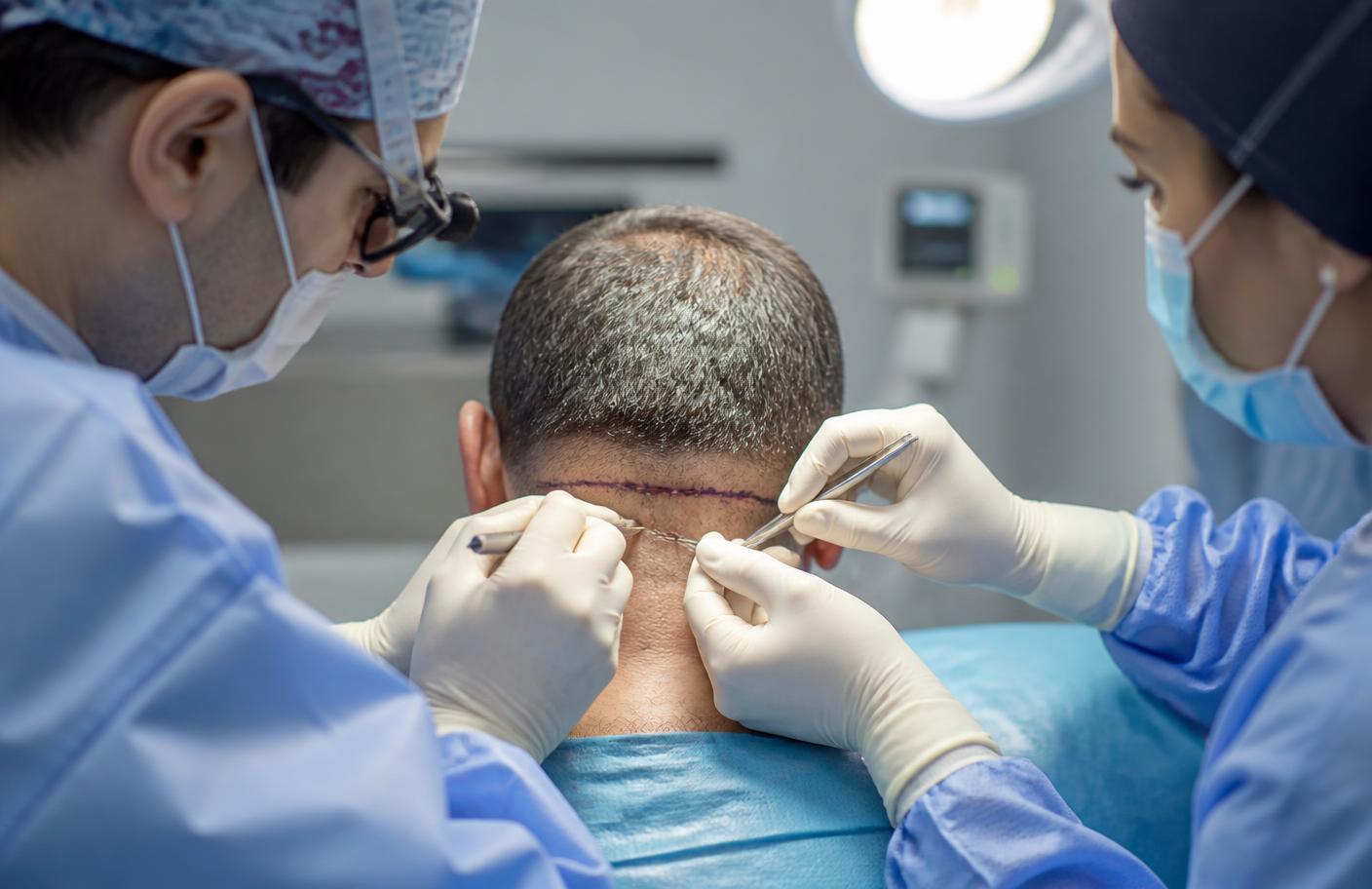
Follicular Unit Transplantation (FUT) remains the highest-yield hair restoration technique available for advanced baldness. A thin strip of DHT-resistant scalp is removed from the permanent donor zone, dissected into individual follicular units under microscopes, and implanted where coverage is needed most.
- Procedure time
- 5 – 8 hours
- Anaesthesia
- Local
- Grafts per session
- 2,000 – 4,500
- Sutures removed
- Day 10 – 14
- Donor scar
- Fine line hidden by hair
- Final result
- 10 – 12 months
What is FUT hair transplant?
FUT, also called the strip technique, harvests grafts from an elliptical piece of scalp taken from the mid-occipital region — the safest, most permanent part of the donor zone. The strip is closed with a trichophytic technique that encourages hair to grow through the healed line, and the removed tissue is then dissected under stereo microscopes into individual follicular units.
Because dissection happens under direct magnification with the follicle fully visible, transection rates in experienced hands are extremely low and grafts retain a protective cushion of surrounding tissue. That cushion is why FUT grafts are famously robust: they tolerate handling well and reliably deliver strong survival percentages.
FUT is not an outdated technique. It is a specific tool chosen for specific anatomy — large bald areas, patients with low donor density spread over a wide area, and repair cases where maximum yield from a limited donor is essential.
How the FUT procedure is performed
The strip surgery day is calm and methodical, and the majority of the time is spent on microscopic dissection rather than on the patient.
1. Donor assessment
Scalp laxity is measured to determine safe strip width, ensuring closure without tension — the single biggest factor in scar quality.
2. Strip excision
Under local anaesthesia, a narrow ellipse of scalp is removed with the blade angled parallel to the follicles to protect the hairs at the edges.
3. Trichophytic closure
One wound edge is de-epithelialised so hair grows through the healed line, camouflaging it further.
4. Microscopic dissection
Technicians slice the strip into slivers and then into single follicular units under stereo microscopes, sorting them by hair count.
5. Recipient site creation
The surgeon makes micro-incisions matching the natural angle, direction and density pattern of the region being restored.
6. Placement
Single-hair grafts define the hairline; three- and four-hair grafts create density behind it for maximum visual impact.
Benefits of FUT
For the right anatomy, FUT outperforms every alternative on pure graft numbers per session.
Maximum graft yield
A single strip session can produce more usable grafts than an equivalent FUE session on the same donor area.
Donor density preserved elsewhere
Grafts come from one narrow band, leaving the rest of the donor zone untouched for future sessions.
Excellent graft quality
Microscopic dissection preserves perifollicular tissue, which supports survival and post-operative growth.
No shaving of the whole head
Only the strip line is trimmed, so surrounding hair covers the donor site immediately.
Cost-efficient for large areas
Per-graft cost is usually lower than FUE for high-volume cases.
FUT recovery and aftercare
Recovery differs from FUE mainly in the donor area, where sutures or staples require care for the first two weeks.
Days 1 – 3
Tightness across the back of the scalp is normal. Analgesics and avoiding neck flexion keep it comfortable.
Days 4 – 9
Gentle washing resumes; recipient crusts begin clearing. Avoid stretching the donor line.
Days 10 – 14
Sutures or staples are removed at the clinic and the line settles into a fine seam.
Weeks 3 – 8
Transplanted shafts shed while roots remain in place — the expected shock-loss phase.
Months 4 – 12
Progressive thickening, with the mature result visible at around one year.
Ongoing
Heavy neck-stretching exercise is deferred for four weeks to protect scar quality.
FUT vs FUE: which one is right for you?
Neither technique is universally superior. The right choice depends on the size of the bald area, your donor characteristics, how short you wear your hair and how much downtime you can accept.
Choose FUT when
You need a very high graft count in one sitting, your donor density is modest, or you keep your hair long enough to cover a fine donor line.
Choose FUE when
You wear very short crops or fades, want minimal downtime, or need to source grafts from the beard or body.
Scarring
FUT leaves one fine linear seam; FUE leaves scattered pinpoint dots. Both are inconspicuous at appropriate hair lengths.
Downtime
FUE patients typically return to work in two to three days; FUT patients in four to six days because of donor healing.
Combination approach
Advanced cases sometimes use both, harvesting a strip first and supplementing with FUE for extra grafts.
Answers
FUT Hair Transplant — FAQs
Ready to see what your hair can look like again?
Book a consultation with our hair transplant surgeon for a trichoscopic assessment, an honest graft estimate and a written treatment plan.