Beard Hair Transplant in Visakhapatnam
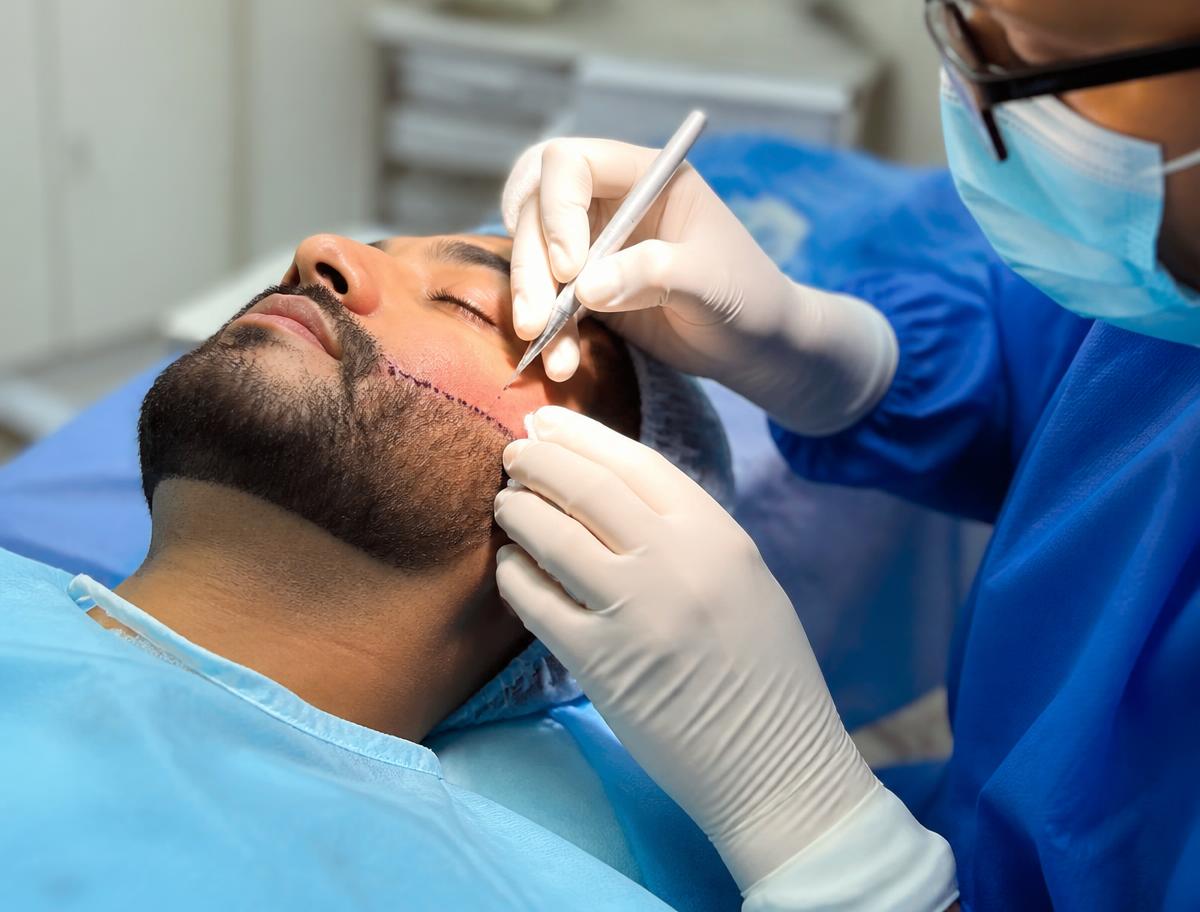
A beard hair transplant fills patchy cheeks, sparse jawlines, moustache gaps and scarred areas using DHT-resistant grafts from the back of the scalp, placed at the flat, acute angles that make facial hair look genuinely native rather than implanted.
- Procedure time
- 4 – 7 hours
- Grafts required
- 800 – 3,000 depending on goal
- Anaesthesia
- Local
- Back to work
- 3 – 5 days
- Shaving allowed
- After 3 weeks
- Final result
- 8 – 12 months
What is a beard hair transplant?
A beard transplant relocates individual follicular units — almost always single-hair and two-hair grafts — from the occipital scalp to the face. Because facial hair exits the skin at a much shallower angle than scalp hair, typically 10 to 20 degrees, recipient sites must be created differently from a scalp case. Getting that angle wrong is the single most common reason a beard transplant looks artificial.
The design phase is equally important. Cheek lines, the moustache-to-beard junction, the goatee border and the jawline transition all follow natural anatomical rules, and they must be drawn to complement your face shape rather than copied from a template.
Grafts placed on the face behave like scalp hair: they continue to grow and need trimming, and they respond to shaving and styling just as native beard hair does.
Ideal candidates for beard restoration
Beard transplant suits a wider range of patients than most people assume, because the goal is contour and density rather than covering an entire bald surface.
Patchy or uneven beard growth
Genetically sparse cheeks or gaps that never filled in after adolescence.
Scar camouflage
Acne scarring, surgical scars, burn scars or cleft-lip repair sites within the beard region.
Thin or absent moustache
Gaps under the nose or an incomplete moustache-to-beard connection.
Post-laser or trauma loss
Facial hair lost after laser hair removal, injury or previous procedures.
Gender-affirming facial hair
Building a masculine beard pattern as part of transition care.
Adequate scalp donor supply
You need a healthy donor zone; this is confirmed at consultation.
The beard transplant procedure
The technique used is FUE, since it allows selective harvesting of fine single-hair grafts that match beard calibre.
1. Design and marking
Beard borders are drawn while you are seated upright and reviewed with you in a mirror before anything begins.
2. Donor selection
Finer follicles from the lower occipital region are chosen because their calibre most closely matches facial hair.
3. Extraction
Grafts are harvested individually with a 0.7 to 0.8 mm punch and sorted by hair count.
4. Recipient site creation
Sites are made at an acute 10 to 20 degree angle, all pointing downward and outward in the natural growth direction.
5. Implantation
Single-hair grafts define the borders; two-hair grafts add density in the core of the beard.
6. Review
Symmetry is checked from multiple angles under different lighting before you leave.
Recovery after beard transplant
Facial skin heals quickly and has an excellent blood supply, which works in your favour.
Days 1 – 3
Tiny crusts form around each graft and mild facial swelling may occur. Sleep with the head elevated.
Days 4 – 7
Gentle washing begins; crusts start to flake away naturally. Do not pick them.
Days 8 – 10
The face looks close to normal and most patients are comfortable in social settings.
Week 3
Shaving with an electric trimmer is permitted; razor shaving from week four.
Weeks 3 – 8
Transplanted hairs shed while roots remain — the normal shock-loss phase.
Months 4 – 10
New beard hair emerges and thickens; final density is judged at around ten months.
Benefits of beard hair transplant
The result is permanent, entirely your own hair, and completely under your control stylistically.
Permanent facial hair
Donor follicles keep their DHT resistance and continue growing for life.
Full styling freedom
Shave, trim, shape or grow it out exactly as you wish once healed.
Effective scar camouflage
Hair growing through a scar hides it far more convincingly than any topical product.
Natural density gradient
Single hairs at the borders and multi-hair grafts in the centre reproduce a natural beard pattern.
Single-day procedure
Completed under local anaesthesia with same-day discharge.
Answers
Beard Hair Transplant — FAQs
Ready to see what your hair can look like again?
Book a consultation with our hair transplant surgeon for a trichoscopic assessment, an honest graft estimate and a written treatment plan.