Direct Hair Implantation
DHI Hair Transplant in Visakhapatnam
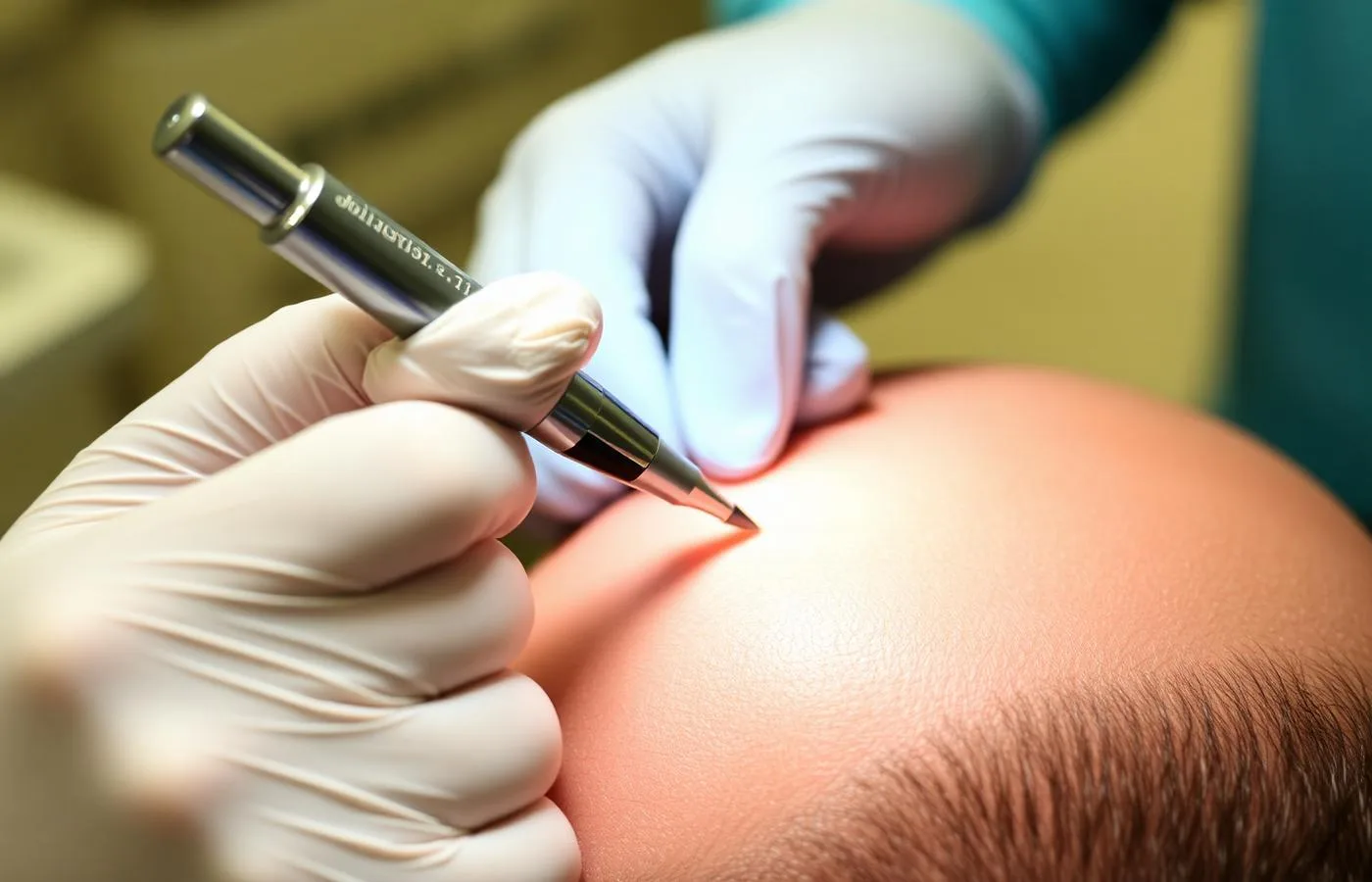
Direct Hair Implantation (DHI) places each graft with a Choi implanter pen, which creates the incision and inserts the follicle in a single movement. Because no pre-made channels are needed, grafts spend less time outside the body and can be packed more densely at precisely controlled angles — which is why DHI is our preferred method for hairlines, crowns and unshaven cases.
- Procedure time
- 7 – 10 hours
- Anaesthesia
- Local, with sedation option
- Grafts per session
- 1,500 – 3,500
- Shaving
- Partial or unshaven possible
- Back to work
- 2 – 3 days
- Final result
- 10 – 12 months
What is DHI (Direct Hair Implantation)?
DHI is an implantation technique, not a separate way of harvesting. Grafts are still extracted individually from the donor zone exactly as in FUE. The difference is what happens next. In conventional FUE the surgeon first creates all the recipient incisions and then places grafts into them with forceps. In DHI, each follicle is loaded into a hollow-needle implanter pen and the same instrument makes the incision and delivers the graft in one action.
That single action gives the surgeon direct control over three variables at the moment of placement: depth, angle and direction. Fine adjustment of all three is what makes a transplanted hairline read as natural instead of uniform, and it is why implanter pens are the standard for frontal work.
The practical benefit is graft handling. Follicles are touched less, spend less time out of the body, and are delivered into a fresh incision that has not had time to bleed or contract. Denser packing becomes possible without compromising blood supply to each unit.
Benefits of DHI hair transplant
DHI is chosen when precision and density in a defined area matter more than raw graft volume.
Higher achievable density
Grafts can be placed closer together with controlled spacing, useful for hairlines and crowns.
Exact angle control
The implanter sets direction and angle per graft, matching whorl patterns and natural exit angles.
Minimal graft handling
Follicles are loaded once and delivered directly, reducing mechanical trauma.
Shorter out-of-body time
Extraction and implantation can run in parallel, improving survival rates.
Unshaven option
Selected cases can be treated without shaving the recipient area, which suits professionals and women.
Less bleeding
Simultaneous incision and placement means incisions are not left open, so the field stays cleaner.
How DHI is performed
The day runs much like an FUE, with implantation performed pen by pen rather than in two separate stages.
1. Assessment and design
Trichoscopy, graft calculation and hairline marking, reviewed with you in the mirror before starting.
2. Anaesthesia
Donor and recipient areas are numbed under local anaesthesia with a ring block.
3. Extraction
Follicular units are harvested with a micro punch and transferred to chilled holding solution.
4. Loading the implanters
Each graft is loaded into a Choi pen of a calibre matched to its thickness and hair count.
5. Direct implantation
The pen creates the incision and places the graft in one movement at the planned depth, angle and direction.
6. Density grading
Single-hair grafts define the front row; multi-hair grafts build bulk behind it.
7. Final check
Angles and spacing are reviewed across the whole recipient zone under magnification.
8. Discharge
Aftercare, medication and a next-morning review call are arranged before you leave.
DHI recovery timeline
Healing is quick because incisions are small and made only where a graft is going.
Days 1 – 3
Mild swelling and pinpoint crusting; sleep elevated and avoid touching the area.
Days 4 – 10
Gentle washing begins and crusts clear; the recipient area looks tidy sooner than in strip-based methods.
Weeks 3 – 8
Transplanted shafts shed while the roots remain anchored.
Months 3 – 5
Fine new hair appears and progressively thickens.
Months 6 – 9
Hairline shape and frontal density become clearly visible.
Months 10 – 12
Full calibre and final density; normal styling and cutting resume long before this.
Is DHI right for you?
DHI suits patients who need high density in a defined zone — a receding hairline, temporal points, the crown, or filling between existing hairs where forceps placement risks damaging native follicles. It is also the technique of choice when the recipient area cannot be shaved.
For very large sessions covering the entire scalp, DHI is slower and often more expensive per graft than Adv FUE. In those cases we frequently combine methods: DHI for the hairline and frontal zone, conventional FUE placement behind it.
Candidacy depends on donor density, scalp laxity and stability of hair loss, all assessed at consultation with trichoscopy and blood investigations.
Answers
DHI Hair Transplant — FAQs
Ready to see what your hair can look like again?
Book a consultation with our hair transplant surgeon for a trichoscopic assessment, an honest graft estimate and a written treatment plan.